What Is Thumb Palm?
Thumb Palm is a concealed position in which a coin is held near the base of the thumb.

From the audience’s viewpoint, the hand appears empty even though the coin remains securely hidden.
The position is especially useful for coin productions, vanishes, switches and routines where the fingers must remain free.
Why Learn Thumb Palm?
Thumb Palm gives you a different type of concealment from Finger Palm. Because the coin sits higher in the hand, your fingers can remain relatively free for gestures and other actions.
It can also act as a temporary holding position while a coin is transferred into another grip or prepared for a production.
Once mastered, Thumb Palm becomes a versatile tool that can be used throughout many complete coin routines.
Before You Begin
Start with a medium-sized coin that fits comfortably near the base of your thumb.
Use only enough pressure to stop the coin from falling. Excess pressure will make the thumb and hand look stiff.
Practise over a soft surface at first in case the coin slips.
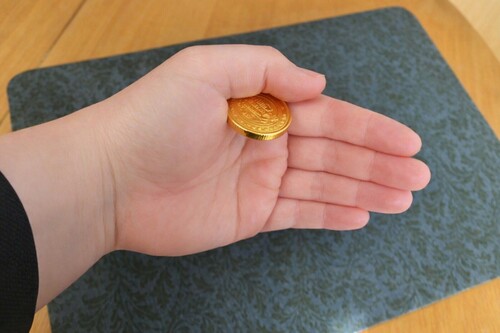
Position the Coin
Place the coin near the crease between the base of your thumb and the side of your hand.
Slide the coin gently into the position shown in the photograph.
The coin should sit securely without requiring a tight grip.
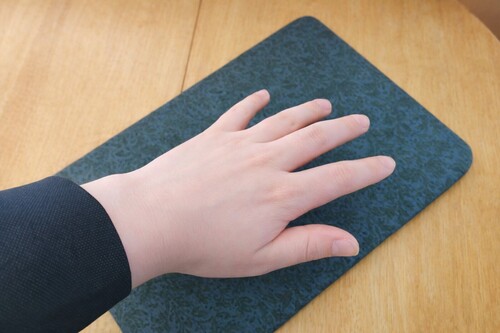
Relax the Hand
Once the coin is secure, relax the fingers and allow the hand to return to its natural shape.
From the audience’s side, the hand should appear completely empty.
You should still be able to move your fingers, point, gesture or mime ordinary actions without revealing the coin.
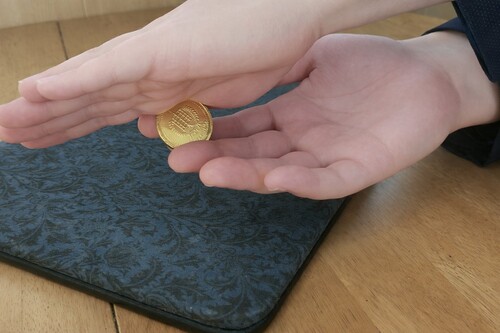
Prepare the Coin for Production
As your opposite hand passes across, secretly move the coin from Thumb Palm toward the fingertips.
Clip the coin between two fingers while the passing hand provides momentary cover.
This creates the impression that the coin has appeared from nowhere.
Animated Demonstration
The animation below shows how Thumb Palm can be used as the starting position for a visual coin production.
Make the Hand Look Natural
The most important part of Thumb Palm is not holding the coin. It is preventing the hand from looking as though it is holding anything.
Keep the thumb relaxed and avoid pressing it tightly against the side of the hand.
Let the fingers remain loose and use the hand for ordinary gestures rather than hiding it unnecessarily.
🎩 Magic Tip
A concealed coin is rarely noticed by itself. What attracts suspicion is a rigid thumb, tense fingers or a hand that suddenly stops moving.
Practice Exercise
Place a coin into Thumb Palm and hold it there for several minutes.
Practise pointing at objects, turning pages, opening a door and picking up a lightweight item.
Compare the hand containing the coin with your genuinely empty hand. Both should have the same shape and level of relaxation.
Finally, practise moving the coin from Thumb Palm to the fingertips while your opposite hand passes across for cover.
Common Mistakes
Do not squeeze the coin too tightly.
Avoid holding the thumb rigidly against the side of the hand.
Do not keep the hand frozen or hidden after concealing the coin.
Make sure the coin does not protrude beyond the base of the thumb.
Avoid looking at the hand containing the hidden coin.
Where Thumb Palm Is Used
Coin Productions
Move the coin from Thumb Palm to the fingertips and make it appear from empty space.
Coin Vanishes
Retain a coin secretly while the audience believes it has been transferred elsewhere.
Coin Switches
Conceal one coin while openly displaying or exchanging another.
Longer Routines
Use Thumb Palm as a temporary holding position during multi-phase coin magic.
Thumb Palm or Finger Palm?
Finger Palm holds the coin lower in the hand and is especially useful after false transfers such as the French Drop.
Thumb Palm holds the coin near the base of the thumb and can leave the fingers more available for other actions.
Neither position is better in every situation. Learning both allows you to choose the concealment that best suits the next move in your routine.