The Performance
David Copperfield has presented many large-scale television illusions, including his famous disappearance of the Statue of Liberty.
In the giant saw routine, Copperfield appears to be secured inside a wooden framework while a huge circular saw passes through the centre of his body.
His upper and lower body then appear to rest on separate wheeled platforms. Assistants move the platforms apart, making the separation seem unmistakable.
The sequence is eventually reversed. The platforms are brought together, the saw action is rewound and Copperfield appears fully restored.
Watch the Giant Saw Performance
A Commonly Proposed Explanation
The exact working of a professional illusion belongs to its designer and performers. However, one frequently discussed explanation uses a second performer, concealed body positions and specially constructed stage apparatus.
In this proposed method, the visible legs and feet do not belong to the person whose upper body the audience sees.
A concealed assistant supplies the lower half of the apparent body while the principal performer curls or folds into a hidden position inside the cabinet.
Watch the Proposed Method
The following video demonstrates a possible general principle behind this type of stage illusion.
How the Illusion May Be Structured
1. Concealed Positioning
The principal performer may draw their legs into a specially designed hidden space inside the apparatus.
2. A Second Performer
An assistant may provide the visible lower legs and feet, creating the impression of one continuous body.
3. Costume Cover
Loose clothing can disguise the transition between the visible upper and lower body sections.
4. Engineered Saw Path
The blade may travel through a protected central channel that remains safely clear of both performers.
5. Divided Platforms
The two wheeled sections strengthen the illusion by allowing the apparent body halves to move apart.
6. Timed Restoration
Lighting, movement and audience attention provide time for the performers to return to their finishing positions.
Illustration of the Proposed Principle
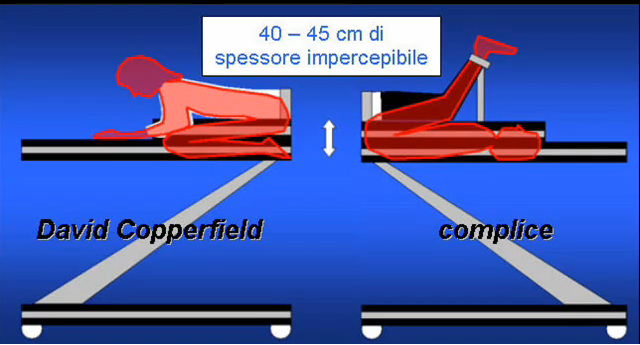
The diagram shows the general idea of two performers combining their visible body sections to create the appearance of one person lying inside the apparatus.
Why the Illusion Is So Convincing
The audience sees a familiar human outline and automatically assumes the visible upper body, clothing, legs and feet belong to one person.
The enormous saw, dramatic music and apparent danger focus attention on the blade rather than on the precise construction of the cabinet.
Moving the two platforms apart provides a powerful visual proof. Once the audience accepts the body as genuine, the separation seems impossible to explain.
Important Safety Notice
This page discusses a professional theatrical illusion for historical and educational interest.
It is not a construction guide. Large saw illusions require specialist engineering, trained assistants, rehearsals, protective systems and professional stage supervision.
Never attempt to reproduce this effect with real cutting machinery.
🎯 Illusion Design Principles
What We Can Learn From It
Grand illusions rarely depend on one secret alone. Their impact comes from combining apparatus, choreography, costume, lighting, sound, timing and audience psychology.
Even close-up magicians can learn from this approach. A simple method becomes much stronger when every movement supports the same story.
🎩 Magic Tip
The best illusions do not merely hide a method. They guide the audience toward a convincing but incorrect explanation of what they are seeing.