The Effect
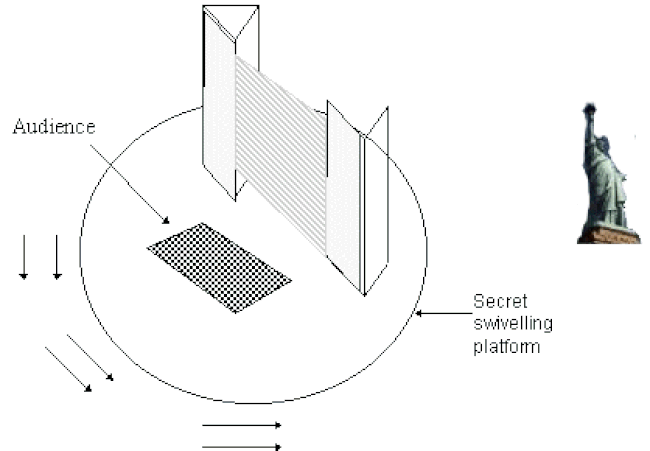
The live audience sits facing the Statue of Liberty, which is visible between two large illuminated supports.
A curtain is raised, briefly blocking the view.
When the curtain is lowered, the statue appears to be gone.
The surrounding lights remain visible, making the disappearance seem even more impossible.
The Rotating Platform Theory
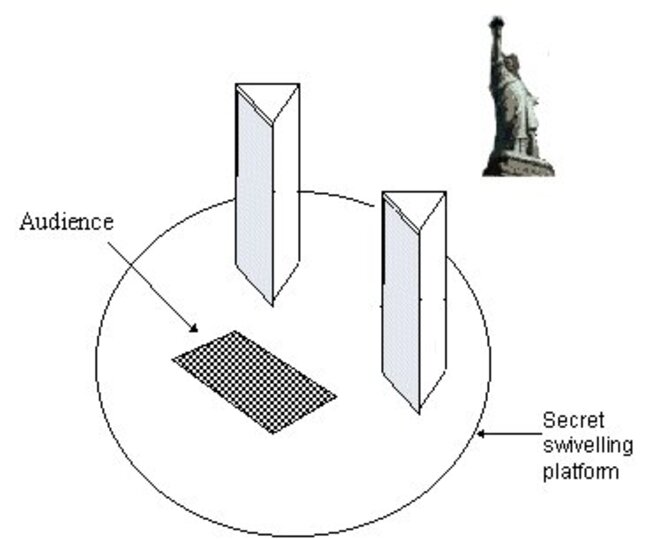
One widely discussed explanation suggests that the audience was seated on a large platform capable of rotating very slowly.
While the curtain blocked the view, the platform may have turned just enough to shift the audience’s sightline away from the real statue.
Because the movement was gradual, spectators would not feel an obvious change in direction.
Why the Audience Would Not Notice
The audience’s attention was directed toward the curtain, narration and bright stage lighting.
A slow rotation can be difficult to detect when there are no nearby fixed reference points.
Darkness around the viewing area would further reduce visual clues.
The Role of the Bright Lights
Powerful lights on the stage supports helped control what the audience could see.
Looking toward bright lights in darkness temporarily reduces the eye’s ability to detect detail in the background.
This made the empty sightline appear convincing while obscuring distant landmarks.
Duplicate Reference Lights
The illusion theory also suggests that a second set of lights recreated the visual frame around the statue.
When the audience platform turned, those duplicate lights occupied the same apparent position as the original stage frame.
The audience therefore believed they were still looking in exactly the same direction.
Darkening the Statue
Turning off or reducing illumination on the Statue of Liberty would make it far less visible against the night sky.
Even without any physical movement of the landmark, darkness and controlled viewing angles could make it disappear from sight.
The Radar Display
The broadcast included a radar-style display that appeared to confirm the statue had vanished.
In the proposed explanation, that display would have been part of the theatrical presentation rather than independent proof.
The Reappearance
The curtain was raised again, giving the platform time to rotate back toward the original sightline.
The statue’s lights were restored.
When the curtain dropped, the Statue of Liberty appeared to have returned.
Why the Illusion Was So Convincing
The object being vanished was enormous and familiar.
The audience could see the surrounding area before and after the effect.
The use of live spectators, searchlights and television presentation made the event feel independently verified.
Most importantly, the method did not need to move the statue—only the audience’s viewpoint.
Important Note
The exact working has never been publicly confirmed by David Copperfield. The explanation below describes a widely discussed theory based on controlled sightlines, lighting and a slowly rotating audience platform.
Key Stagecraft Lessons
Control the View
A magician does not always need to move the object if the audience’s sightline can be changed.
Use Light Carefully
Bright foreground lighting can hide distant details.
Remove Reference Points
Slow movement is harder to detect without fixed visual markers.
Layer the Convincers
Curtains, radar graphics, spectators and searchlights all reinforced the same impossible story.
🎭 Category
Grand Illusion
👀 Principle
Sightline Control
🎬 Setting
Staged Television Special