The Effect
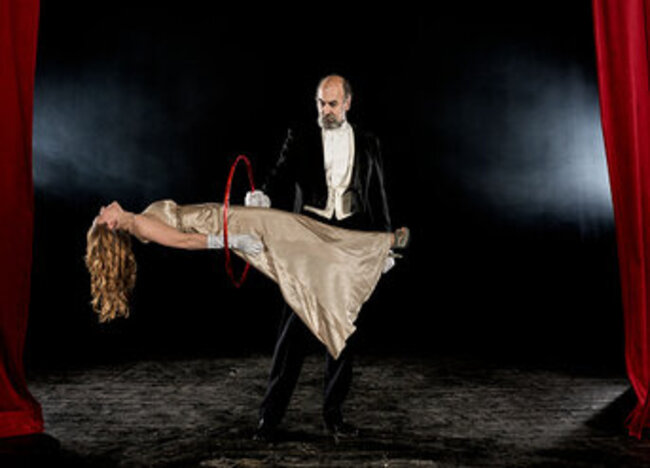
An assistant is brought to centre stage and placed in a reclining position on a couch.
A large cloth is draped over the assistant.
On the magician’s command, the covered figure rises about a foot above the couch.
The couch is removed and the magician appears to walk around the floating body.
The Vanishing Climax
The covered figure rises higher, sometimes above the magician’s head.
It then lowers slightly before beginning to float upward again.
At the climax, the magician pulls away the cloth and the assistant appears to have vanished in mid-air.
The Broad Secret
In the classic explanation, the illusion depends on two main pieces: a prepared couch and a lightweight body-shaped form beneath the cloth.
The couch contains a concealed space that allows the assistant to leave the visible performance position.
The body-shaped form preserves the outline of a person beneath the cloth.
The Prepared Couch
The couch appears to be a simple piece of stage furniture.
Its real purpose is to provide concealment and a hidden route for the assistant during the covered phase.
Once the assistant is concealed, the couch can be removed from the stage, taking the performer safely out of view.
The Body-Shaped Form
A lightweight mesh or frame can be shaped to resemble the outline of a reclining person.
When covered by the cloth, the form appears to be the assistant’s body.
The form can then be raised and lowered by concealed stage control.
How the Switch Happens
As the magician lifts and arranges the cloth, the body-shaped form is positioned over the assistant.
Once the cloth fully conceals the scene, the audience can no longer distinguish the real assistant from the artificial shape.
The assistant moves into the couch’s concealed compartment while the cloth-covered form remains visible.
Creating the Levitation
The covered form is raised and lowered by hidden stage equipment controlled from offstage or above.
The magician times gestures and commands to match those movements.
Careful choreography makes the levitation appear responsive to the magician’s actions.
Why the Form Is Hard to See
Dark scenery helps conceal thin mesh, support lines and mechanical details.
Black or transparent materials blend into the stage background.
Strong front lighting and controlled audience sightlines direct attention toward the cloth rather than the hidden structure.
The Final Vanish
When the cloth is pulled away, only the lightweight form remains.
From the audience’s viewpoint, the uncovered form blends into the dark background and appears to vanish.
The stage crew can then raise or remove it completely.
Why the Audience Forgets the Couch
The couch seems to play only a supporting role at the start.
Once the floating figure rises, attention shifts upward and the couch is mentally dismissed.
That change in attention allows the most important piece of apparatus to leave the stage without seeming significant.
🎩 Stagecraft Principle
The strongest secret props are often introduced early as ordinary scenery, then removed before the audience realizes their importance.
⚠️ Professional Safety Notice
This page explains the theatrical principle only. Human levitation apparatus must be professionally engineered, load-tested, rehearsed and operated by an experienced stage crew.
Performance Considerations
The routine requires precise coordination between the magician, assistant and hidden crew.
Cloth handling must remain smooth so the concealed switch is never telegraphed.
Music, lighting and pacing help make the levitation feel elegant rather than mechanical.
The magician’s movement around the floating figure must stay within the apparatus limits.
Stage Versus Television
This style of illusion is strongest in a theatre where viewing angles, lighting and distance are controlled.
Close television cameras can reveal fine movement or mesh that would remain invisible to a live audience.
Broadcast versions therefore often use modified apparatus, restricted camera positions or different methods.
🎯 Skills Used
Common Misconceptions
The assistant is not simply hanging beneath the cloth throughout.
The couch is not ordinary furniture.
The final vanish relies on stage concealment, not genuine disappearance.
The effect cannot be safely improvised with household materials.