What It Does
A Natural Way to Control a Selected Card
The Double Undercut is one of the simplest and most convincing ways to move a selected card to a known position in the deck.
A single undercut could accomplish the same basic control, but dividing the action into two smaller cuts looks more casual and less suspicious.
🎩 Why It Is Useful
Once the selected card is controlled to the top, you can continue into countless revelations, forces, changes, palms and other card routines.
The Starting Position
Keep a Break Above Their Card
Ask the spectator to return their selected card while you hold the deck open for them.
As the two halves are brought back together, secretly keep a pinky break immediately above the selected card.
This break tells you exactly where the selected card sits and separates the deck into the two packets needed for the control.
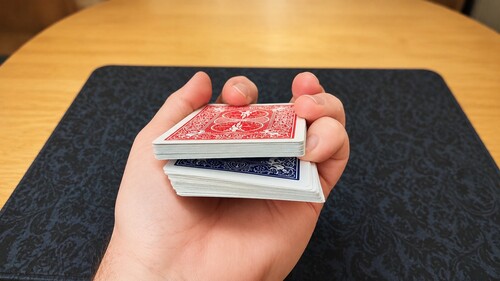
Hold the Pinky Break
Let the spectator replace their selected card and square the deck while keeping a small pinky break above it.
The break should be invisible from the spectator's normal viewing angle.
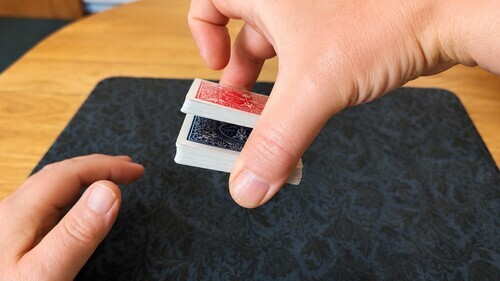
Transfer the Deck to Biddle Grip
The deck begins in your non-dominant hand. Transfer it to your dominant hand in a Biddle-style grip.
As you make the transfer, move control of the break from your pinky to the thumb and fingers of the dominant hand.
Keep the movement relaxed so it looks like an ordinary change of grip.
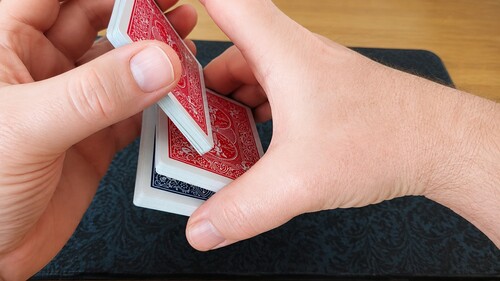
Make the First Undercut
With your non-dominant hand, peel away roughly half of the cards below the break.
Bring that packet around and place it on top of the deck.
This is the first of the two casual cuts that disguise the control.
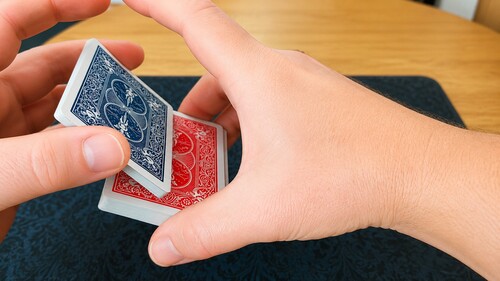
Complete the Second Undercut
Peel away the remaining cards below the break.
Place this packet on top of the deck as well.
The two-part action should look like nothing more than a relaxed, casual cut.
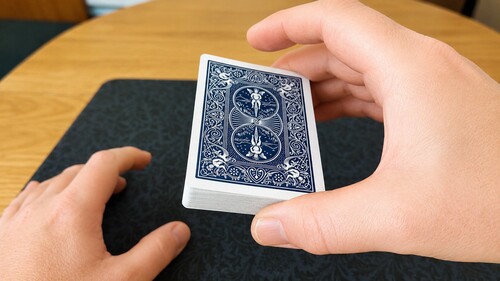
The Selected Card Is Now on Top
After the second undercut, the spectator's selected card has been secretly transferred to the top of the deck.
From the audience's point of view, you simply cut the deck twice after their card was returned.
Controlling the Card to the Bottom
The same basic idea can also be used to move the selected card to the bottom of the deck.
Instead of holding the break above the selected card, hold the pinky break directly beneath it before beginning the undercut.
💡 Choose the Position Before You Begin
Decide whether your next trick requires the selected card on top or on the bottom, then place the break on the appropriate side of the card.
Performance Tips
🖐 Keep the Break Small
A tiny pinky break is enough. A large gap can become visible from the side.
🔄 Make the Cuts Equal
Avoid making one huge cut and one tiny cut. Two reasonably balanced packets look more natural.
👀 Don't Watch Your Hands
Look at the spectator and continue talking while you make the cuts.
🎭 Treat It as Nothing
The Double Undercut works best when the action is not presented as an important moment.
Common Mistakes
The pinky break is visible
Reduce the gap and keep the deck angled naturally towards the spectator.
The grip change looks awkward
Practise transferring the deck into Biddle grip without pausing or looking directly at the break.
The cuts look deliberate
Keep both packets moving continuously. The two cuts should feel like one relaxed action.
The selected card ends up in the wrong place
Check whether your break is above or below the card before beginning.
Practice Plan
1. Practise the Break
Learn to hold a tiny pinky break while keeping the deck looking completely squared.
2. Practise the Transfer
Move from pinky break to dominant-hand thumb break smoothly and without hesitation.
3. Join the Two Cuts
Perform both undercuts in one continuous rhythm.
4. Add Conversation
Rehearse the sleight while speaking so your attention is not fixed on your hands.