The Effect

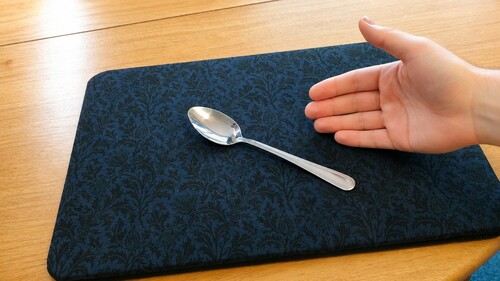
An ordinary metal spoon is shown openly.
The performer holds the spoon at the handle and appears to bend it backward and forward with almost no effort.
The spoon seems soft and rubbery for a few moments.
It is then placed on the table completely straight and can be examined.
What You’ll Need
🥄 Metal Spoon
Use an ordinary spoon with a straight handle.
🪙 Small Silver Coin
A dime, small silver-coloured coin or similar object works well.
🪞 Mirror or Camera
Essential for checking the audience view and exposed angles.
The Secret
The spoon is not bent.
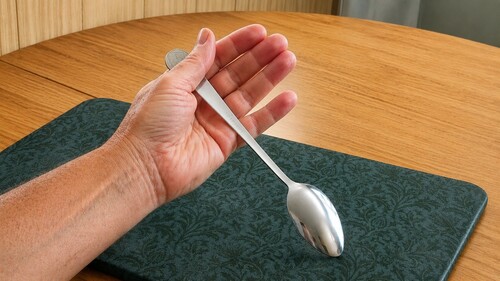
A small silver coin is positioned above the end of the spoon handle. From the audience’s viewpoint, the coin looks like the top end of the handle.
The real spoon handle is allowed to pivot behind the hand.
Because the visible coin stays in place, the audience believes the handle itself is bending.
Position the Coin
Hold the small silver coin in the hand that will grip the spoon.
Place it just above the end of the spoon handle so it appears to continue the line of the metal.
Grip the Spoon
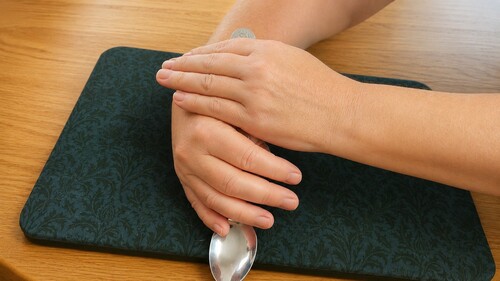
Hold the spoon so the coin remains visible while the actual handle is partly concealed by the hand.
Keep the grip relaxed and natural.
Create the Bending Motion

Move the spoon backward and forward behind the hand.
Keep the coin almost stationary so the audience believes it is the end of the spoon handle.
The movement should be smooth rather than fast.
Restore the Spoon
Gradually reduce the movement and bring the real handle back into line with the coin.
Lower the spoon to the table and secretly retain or remove the coin.
The spoon can then be handed out for examination.
Why the Illusion Works
The audience sees the silver coin and assumes it is part of the spoon.
Their attention stays on the apparent end of the handle while the real handle moves behind the fingers.
The front viewing angle hides the separation between the coin and spoon.
Best Audience Position
Keep spectators directly in front of you.
Avoid wide groups or anyone standing far to either side.
Hold the spoon at chest height and angle the hand slightly inward.
Do not perform surrounded.
Performance Tips
Show the spoon briefly before beginning, but do not encourage close inspection until the end.
Start with very small movements and increase them gradually.
Use your facial expression and body language to suggest effort or concentration.
Pause after restoring the spoon before placing it down.
🎩 Magic Tip
A slow wobble often looks more impossible than a large, frantic movement. Let the audience see the spoon apparently soften.
Presentation Ideas
Present the effect as temporarily softening the metal.
Claim that heat from your hands changes the spoon’s structure.
Use the routine as a light introduction to metal-bending or mind-power themed magic.
Common Mistakes
Do not let the coin separate visibly from the line of the handle.
Avoid exposed side angles.
Do not squeeze the spoon so tightly that the hand looks unnatural.
Keep the coin still while the spoon moves.
Do not overdo the bending action.
Practice Plan
First practise holding the coin and spoon in alignment.
Next rehearse the pivoting movement slowly in front of a mirror.
Record the trick from the audience’s viewpoint and test several angles.
Add the performance script only after the illusion looks convincing.