The Effect
Two playing cards are placed near the center of the deck
by the spectator. You hold the deck loosely and, in a
rapid movement, appear to grab those cards from the middle
of the pack.
At full speed the action looks surprisingly impossible:
the spectator has apparently buried the cards in the deck,
yet you seem to pluck them out almost instantly.
What You Need
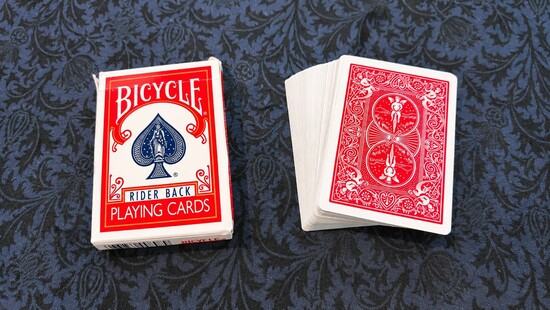
The basic version uses one ordinary deck of playing cards.
The effect can
be done by using two cards from a second deck to form two identical pairs, although using the original method with one deck should be absolutely fine.
Use Number Cards
Using number cards from the deck to make up two pairs rather than
face cards is better, because they are less easy to remember their exact suit and value.
The Secret Setup
Prepare two pairs of cards. One pair should be red and the
other black, with the values matched across the colours.
The original example uses a black 6 and a red 7, together
with a red 6 and a black 7.
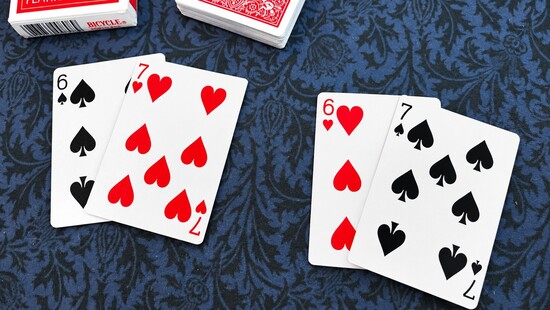
Avoid using face cards. The number cards make it more difficult for your audience to remember the exact suits and values of the cards during the performance.
How to Perform the Trick
Step 1
Prepare Two Matching Pairs
Take two pairs of number cards: one red pair and
one black pair. The value of each red card should
match the value of a black card.
This example uses a black 6 and a red 7,
together with a red 6 and a black 7.
Step 2
Place the First Pair
Place one card from the first pair on top of the
deck and the other card on the bottom.
Square the deck so the arrangement is neat and
ready for the next part of the setup.
Step 3
Complete the Setup
Place the other prepared pair on top of the deck.
This completes the hidden setup.
Square the deck and return it to its box until you
are ready to perform.
Step 4
Let the Spectator Insert the Cards
Remove the deck from its box and deal the top two
cards face up to your spectator.
Ask them to insert the cards anywhere near the
center of the pack.
Step 5
Make the Lightning-Fast Snatch
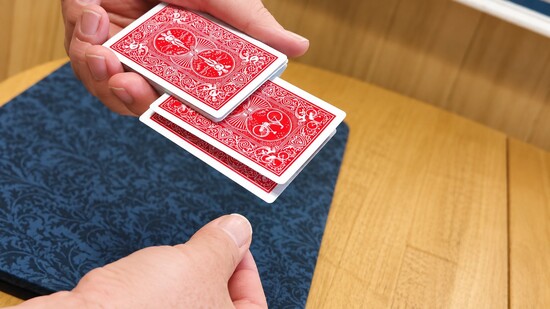
Hold the deck in a loose mechanics grip, supported
on three sides by your fingers and thumb.
Quickly grab the top and bottom card with the
finger and thumb of your other hand.
At normal speed, the action creates the appearance
that the spectator's cards have been plucked from
the middle of the deck.
See It at Full Speed
The slow-motion photograph shows the action clearly. At
normal speed, the movement is much harder to analyse and
the effect looks as though the cards have genuinely been
pulled from the middle of the deck.
Why It Works
The illusion combines a hidden preparation with speed.
The spectator remembers placing the two cards near the
center, while the performer controls the position of the
prepared cards.
The final movement is deliberately fast. With less time
to analyse the action, the audience interprets the visual
moment as the cards being removed from the center.
Performance Tips
Keep the Snatch Continuous
Avoid pausing before the grab. The deck position and
snatching action should flow together naturally.
Practise the Grip First
Become comfortable holding the deck loosely and
reaching for the required cards before adding speed.
Build Speed Gradually
Learn the movement slowly and accurately first.
Increase the speed only after the grip and card
positions are reliable.
Common Mistakes
Using Face Cards
Use number cards because
they are less easy to remember.
Snatching Too Slowly
A slow action gives spectators more opportunity to
analyse what is happening. Increase speed gradually
as your handling becomes reliable.
Making the Setup Obvious
Keep the preparation casual and square the deck
naturally before returning it to its box.
Practice Plan
- Prepare and identify the two matching pairs.
- Practise placing the first pair on top and bottom.
- Add the second pair and square the deck naturally.
- Rehearse the spectator-insertion sequence.
- Practise the snatching action slowly.
- Gradually increase the speed until the action is smooth.
- Perform the complete routine until the snatch feels natural.
Common Questions
Lightning Fast Card Snatch FAQ
How many cards are prepared?
The method uses two pairs of number cards,
giving four prepared cards in total.
Can I use face cards?
Use number
cards rather than face cards because they are
less easy to remember.
Can the trick be practised with two decks?
Yes,
an even better version can be used with two
decks to make two identical pairs, although the basic method is described
with one deck.