The Effect
Three cards are shown: one red winner and two black losers.
The cards are tossed face down onto the table and mixed slowly. The audience follows the winning card, but repeatedly chooses the wrong one.
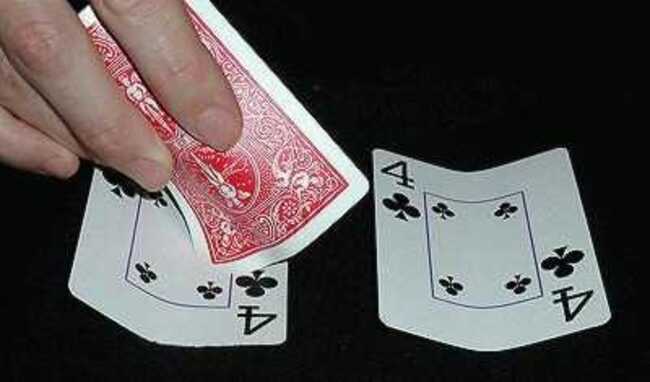
For the final phase, the winning card appears to receive a bent corner. Even with this visible marker, the audience still follows the wrong card.
Credits
Original routine text and photographs are reproduced by kind permission of Andru Luvisi.
The phase-two handling is based on a classic Vernon sequence.
Original text and pictures © 2002 Andru Luvisi.
What You’ll Need
🟥 One Winner
Use a visually distinct card, such as a red Ace.
⬛ Two Losers
Identical losing cards can make the display more deceptive.
🪵 Flat Surface
A close-up mat or smooth table gives better control.
Prepare the Cards
Bend all three cards slightly lengthwise so the backs are convex. When placed face down, the long edges should touch the table while the short ends rise slightly.

Pre-bend the outer-right and inner-left corners of all three cards. This makes later corner changes easier and helps the bends look alike.

Check the Display
Make sure the three cards look natural both face up and face down.


The Basic Throw
Hold two cards in the right hand and one in the left.
In the fair throw, the lower right-hand card is tossed first, followed by the left-hand card, then the final right-hand card.
In the fake throw, the upper card is released first while the lower card is secretly retained.

The Fair Throw
Hold one loser between the right thumb and second finger.
Hold the winner directly beneath it between the right thumb and third finger, with the long left edges touching.
Hold the second loser in the left hand.
Turn both hands palm up to show the faces. Turn the right hand palm down while moving left, stop the hand and release the lower card with the right third finger.
Toss the left-hand card to the far right, then place the final right-hand card between the other two.
The Fake Throw
Begin with the same grip and the same outward appearance.
During the first toss, release the upper card with the second finger while immediately taking control of the lower card.
The movement must match the fair throw exactly.
🎩 Magic Tip
Do not pull the right hand back after the toss. Let it stop naturally, just as it does during the genuine action.
The Bent-Corner Switch
Begin by placing a visible bend in the winner’s corner.
While showing the losing cards, secretly create a matching bend in one loser using the right little finger and third finger.

After a fake throw, the bent loser appears to be the winner. Secretly straighten the winner’s corner before placing it down.

Phase One — Establish the Game
Show the three cards and explain that the object is to follow the red winner.
Perform several fair throws and reveal the winner each time.
Without changing your rhythm, perform a fake throw. Slowly mix the cards and point to the actual winner while suggesting that the audience saw it travel elsewhere.
Turn over the winner and allow the surprise to register.
Phase Two — The Impossible Choice
Use the fake throw and repeat displays of the same losing card to suggest that both other positions contain losers.
The audience believes the winner must be in the remaining position, yet the final reveal contradicts that conclusion.
Keep the presentation light. The goal is to create mystery, not embarrass the spectator.
Phase Three — Bent-Corner Climax
Pick up the winner and press its corner against the two losers, creating an obvious bend.

Display the bent edge clearly, then secretly transfer the bend to a loser during the switch.
Move the cards while watching the audience’s eye and head movement. This tells you who is genuinely following the bent card.
Ask one spectator which card appears to be the winner. When they select the bent loser, acknowledge that it is the logical choice before turning it over.
Watch the Complete Routine
Audience Management
Ask which card appears to be the winner rather than demanding a definite answer.
This lowers the pressure and keeps the experience playful.
When the spectator chooses the bent loser, say that it is a perfectly reasonable choice before revealing the surprise.
Never make a participant feel foolish for being deceived.
⚠️ Perform It as Magic, Not Gambling
Three Card Monte is historically associated with street scams. Present this routine only as entertainment or a demonstration.
Do not take money, encourage betting or use the method to deceive people financially.
Common Mistakes
Do not perform the fake throw faster than the fair throw.
Avoid pulling the throwing hand backward after releasing a card.
Make sure the corner bends look identical.
Do not begin the full routine until the fair and fake throws are visually indistinguishable.
Keep the cards within a compact working area on the table.
🎯 Skills Used
Practice Plan
First practise only the fair throw until it looks relaxed.
Next practise the fake throw separately and compare both actions on video.
Add the bent-corner switch only after the throws are consistent.
Finally rehearse the three performance phases with full patter.